
CD Rate Calculator – Calculate CD Rates, Certificate of Deposit Interest & Growth
A Certificate of Deposit (CD) is a simple way to save money and earn interest for a fixed period. Before opening a CD, it is useful to know how much money you may have at the end of the term.
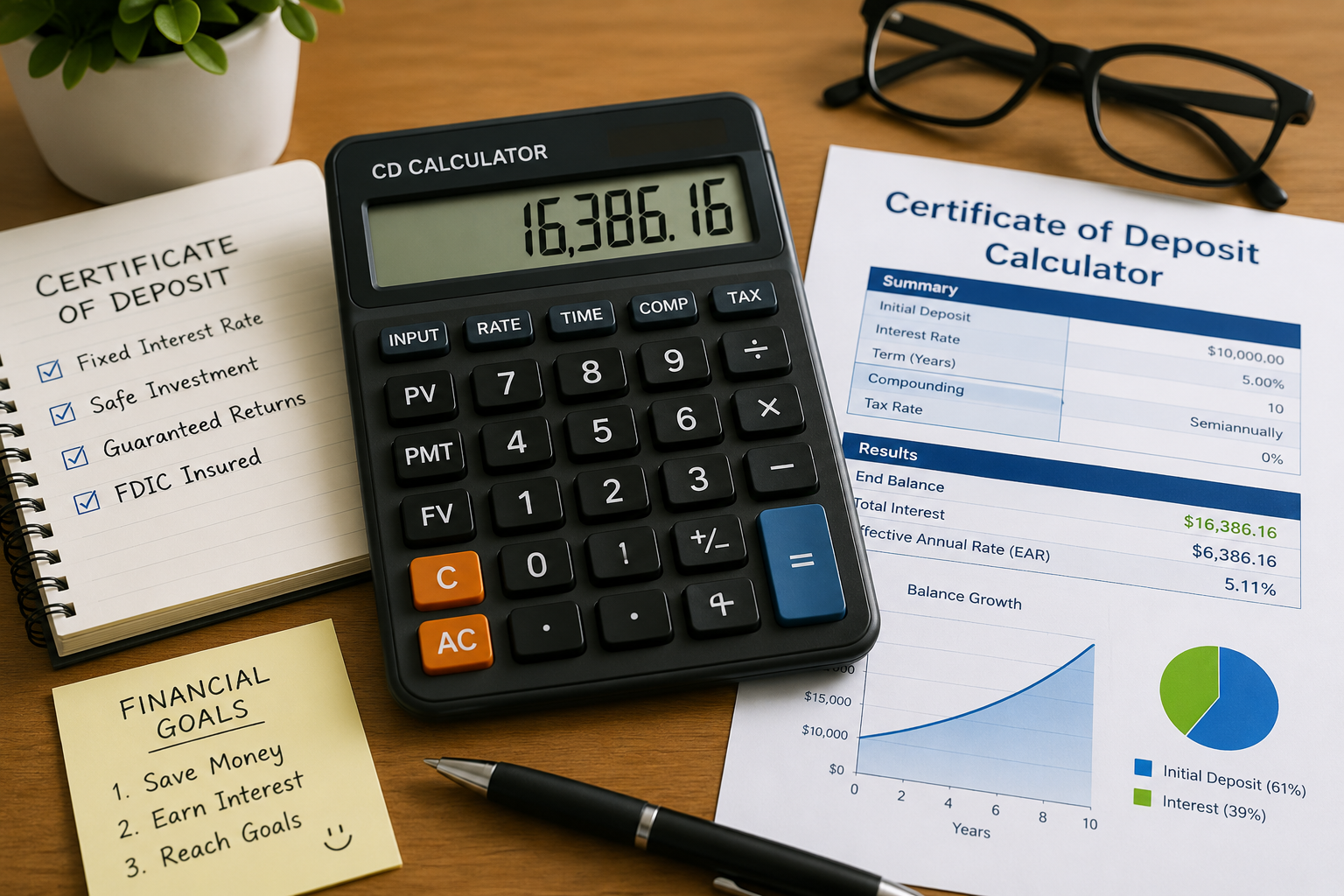
Our CD Rate Calculator, also known as a CD Rates Calculator, helps you estimate your final balance, total interest, and yearly or monthly growth in just a few seconds.
- What Is a Certificate of Deposit?
- What Is a CD Rate Calculator?
- How to Use Our CD Rate Calculator
- CD Calculator Inputs Explained
- What Is Compound Interest?
- Compounding Options in Our Calculator
- Example of a CD Calculation
- CD Rate Calculator Results Explained
- What Is a CD Schedule?
- CDs and Taxes
- Benefits of Using a CD
- Things to Check Before Opening a CD
- CD vs Savings Account
- CD Ladder Strategy
- Frequently Asked Questions
What Is a Certificate of Deposit?
A Certificate of Deposit, commonly called a CD, is a financial product where you deposit money for a fixed period and receive interest on that money.
For example, you may put $10,000 into a CD for 5 years at a fixed interest rate. At the end of the term, you receive your original money plus the interest you earned.
CDs are generally considered lower-risk investments compared with investments such as stocks. They are often used by people who want a more predictable return on their savings.
Suppose you deposit $10,000 into a CD and earn interest for a fixed number of years. A CD calculator can estimate how much the $10,000 may grow during that period.
What Is a CD Rate Calculator?
A CD Rate Calculator is an online tool that helps you estimate the future value of a Certificate of Deposit while comparing different CD rates and terms.
Instead of doing the calculations manually, you enter a few details and the calculator does the work for you.
Our CD Calculator can show:
- Initial deposit
- Interest rate
- Compounding frequency
- Deposit length
- Marginal tax rate
- End balance
- Total interest
- Effective annual rate
- Annual growth
- Monthly growth
- Visual charts
How to Use Our CD Rate Calculator
Using the calculator is very easy. You only need to enter a few values.
Step 1: Enter Your Initial Deposit
Enter the amount of money you want to put into the CD.
Example: $10,000
Step 2: Enter the Interest Rate
Enter the annual interest rate offered by the CD.
Example: 5%
Step 3: Select Compounding
Choose how often interest is compounded.
- Annually
- Semiannually
- Quarterly
- Monthly
- Continuously
Step 4: Enter the Deposit Length
Enter the number of years and months.
For example: 10 years and 6 months.
Step 5: Enter the Tax Rate
If you want to estimate the effect of taxes on your interest, enter your marginal tax rate.
Example: 20%
Step 6: Click Calculate
Click the Calculate button on our CD Calculator. The calculator will show your estimated final balance and total interest.
CD Calculator Inputs Explained
Here is a simple explanation of each input:
| Input | What It Means |
|---|---|
| Initial Deposit | Money you put into the CD at the beginning |
| Interest Rate | Annual rate used to calculate interest |
| Compound | How often interest is compounded |
| Years | Number of complete years |
| Months | Additional months |
| Marginal Tax Rate | Estimated tax rate applied to interest |
What Is Compound Interest and CD Interest?
Compound interest means that you earn interest on your original money and, over time, on interest that has already been added. A CD interest calculator uses this idea to estimate how your certificate of deposit can grow.
This is one reason why the frequency of compounding matters.
Interest can be compounded:
- Once a year
- Twice a year
- Four times a year
- Every month
- Continuously
More frequent compounding means interest is added more often.
Compounding Options in Our Calculator
Our CD Calculator includes five compounding choices.
| Compounding | Times Per Year |
|---|---|
| Annually | 1 |
| Semiannually | 2 |
| Quarterly | 4 |
| Monthly | 12 |
| Continuously | Continuous mathematical model |
Annually
Interest is compounded once per year.
Semiannually
Interest is compounded twice per year.
Quarterly
Interest is compounded four times per year.
Monthly
Interest is compounded twelve times per year.
Continuously
Continuous compounding uses a mathematical model where compounding happens continuously.
Example of a CD Interest Calculation
Let's take a simple example to see how a CD interest calculator can estimate your earnings.
| Initial Deposit | $10,000 |
| Interest Rate | 5% |
| CD Term | 10 years |
| Compounding | Semiannually |
| Tax Rate | 0% |
With these example values, the calculator estimates:
| Result | Amount |
|---|---|
| Initial Deposit | $10,000 |
| Total Interest | $6,386.16 |
| End Balance | $16,386.16 |
CD Rate Calculator and CD Interest Results Explained
1. End Balance
The End Balance is the estimated amount you may have at the end of the selected CD period.
It includes your original deposit and the interest earned.
2. Total Interest
This shows how much interest you earned during the selected period. You can use a CD interest rates calculator to compare the estimated earnings from different rates and terms.
3. Effective Annual Rate
The calculator also shows an effective annual rate based on the selected compounding method.
This helps you understand the effect of compounding over one year.
4. Donut Chart
The donut chart gives you a visual comparison between your initial deposit and the interest earned.
What Is a CD Schedule?
The Accumulation Schedule shows how your money grows over time.
Our calculator provides both an annual schedule and a monthly schedule.
Annual Schedule
The annual schedule shows:
- Year
- Deposit
- Interest
- Ending Balance
| Year | Deposit | Interest | Ending Balance |
|---|---|---|---|
| 1 | $10,000.00 | $506.25 | $10,506.25 |
| 2 | $0.00 | $531.88 | $11,038.13 |
| 3 | $0.00 | $558.81 | $11,596.93 |
| 4 | $0.00 | $587.09 | $12,184.03 |
| 5 | $0.00 | $616.82 | $12,800.85 |
Monthly Schedule
You can also switch to the Monthly Schedule. This gives a more detailed view of the balance and interest for each month.
CDs, Interest and Taxes
Interest earned from CDs may be taxable depending on your country, account type, and tax rules.
In the United States, CD interest is generally taxable as income, although the rules can be different for certain tax-advantaged accounts.
Example
Suppose your interest is $1,000 and your estimated tax rate is 20%.
A simple after-tax estimate would be. This is also the type of calculation you can check with a CD calculator interest tool.
Benefits of Using a CD
1. Saving for a Future Goal
You can use a CD for a future goal such as:
- Buying a car
- Making a home down payment
- Building savings
- Preparing for a planned expense
2. Predictable Returns
Fixed-rate CDs can make it easier to estimate future returns because the rate is set for the CD term.
3. Lower Investment Risk
CDs are generally considered lower-risk investments compared with investments such as stocks.
4. Different Term Options
CDs can have different term lengths, from shorter periods to several years.
Things to Check Before Opening a CD
Interest Rate
Compare the CD rates and CD interest rates offered by different financial institutions. A CD interest rates calculator can make rate comparisons easier.
CD Term
Think about how long you can keep your money invested.
Early Withdrawal Rules
Many CDs can charge a penalty if you withdraw money before maturity.
Minimum Deposit
Some CDs require a minimum amount of money to open the account.
APY
Look at the Annual Percentage Yield (APY) when comparing CD offers because APY takes the effect of compounding into account.
CD vs Savings Account
Both CDs and savings accounts can be used to keep money and earn interest, but they work differently.
| Feature | CD | Savings Account |
|---|---|---|
| Fixed Term | Usually yes | Usually no |
| Access to Money | More restricted | Usually easier |
| Interest Rate | Often fixed | Can change |
| Early Withdrawal | May have a penalty | Usually more flexible |
| Best For | Planned future savings | Accessible savings |
CD Ladder Strategy
A CD ladder is a strategy where you divide your money between several CDs with different maturity dates.
For example, instead of putting all your money into one 3-year CD, you could use different terms:
| CD | Term |
|---|---|
| CD 1 | 1 year |
| CD 2 | 2 years |
| CD 3 | 3 years |
When one CD matures, you can decide whether to use the money or invest it again.
Important Notes Before Using a CD Calculator
Frequently Asked Questions About CD Interest and CD Rates
How are CD rates calculated?
How to calculate CD formula?
What is the CD rate in India?
How much will a $10,000 CD earn in 6 months?
How to manually calculate CD interest?
What is a CD calculator?
Is a CD calculator free?
What information do I need to use a CD calculator?
What is the difference between annual and monthly compounding?
Can I enter months in the CD calculator?
What happens if I enter 0 years and 6 months?
Can I calculate continuous compounding?
Does a higher interest rate always mean more money?
Can I withdraw money from a CD early?
Is CD interest taxable?
What is APY?
Related Financial Tools
If you want to calculate your CD growth quickly, you can also use our CD Calculator to enter your deposit, interest rate, term, compounding frequency, and tax rate.
You can return to the CD Rates Calculator homepage anytime to compare CD rates and use the calculator again.
Final Thoughts
A Certificate of Deposit can be a useful option when you want to keep money invested for a fixed period and earn interest.
Before opening a CD, it is important to understand how much money you may earn and how long your money will be locked in.
Our CD Rate Calculator makes this easier. Enter your deposit, interest rate, compounding method, years, months, and tax rate to get an estimate of your future balance and compare CD rates.
You can also use the annual and monthly schedules and charts to understand how your money may grow over time.
Try the CD Calculator Today
Calculate your estimated CD interest, final balance, and investment growth in seconds.